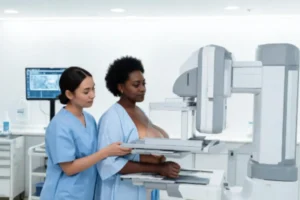
Your doctor has probably referred you to get a mammogram, but you have some questions regarding it.
Firstly, a mammogram is simply an X-ray picture of the breast.
This kind of imaging is really good at picking up unusual breast changes, like lumps or masses that you might not even be able to feel yourself.
Now, finding something on a mammogram doesn’t automatically mean you have cancer, but it does show signs that something might be amiss.
In this piece, we will talk more about mammography, what it’s looking for, the different types, and how you can get ready for it.
What Does a Mammogram Detect?
A mammogram can spot several kinds of abnormalities:
1. Masses:
A mass usually looks like an area of breast tissue that stands out from the rest.
The radiologist will look at its size, shape, how it appears, and if it has changed from any previous images, assuming you’ve had them before.
Some masses have features that tend to be benign, meaning harmless, while others might need more tests to figure out if they’re cancerous.
2. Calcifications:
These are tiny calcium deposits in the breast. They can be really small (micro) or a bit bigger (macro).
If certain types of these calcifications show up in clusters, it might signal a need for more investigation because they could be linked to breast cancer.
3. Breast density:
This refers to the proportion of fibrous and glandular tissue compared to fatty tissue in your breast.
It’s not a disease and it’s actually quite common. But, having dense breasts can make mammograms a bit less effective because both dense tissue and some abnormalities can appear white on the image.
It’s also worth noting that dense breasts might be linked to a slightly higher risk of breast cancer.
Can a Mammogram Diagnose Breast Cancer?
No, it can’t directly. A mammogram can only highlight suspicious areas, but it can’t definitively confirm breast cancer on its own.
If the imaging or screening shows something that raises a concern in the breast tissue, your doctor might suggest a procedure called a biopsy.
This is currently the only sure way to get a confirmed diagnosis of breast cancer.
What Is the Difference Between a Screening Mammogram and a Diagnostic Mammogram?
There are two main types of mammograms you might have. It’s helpful to know which one your doctor is recommending for you.
- Screening mammogram: This is done when you don’t have any breast cancer symptoms or known issues. The idea is to proactively look for signs of breast cancer before any symptoms even show up.
- Diagnostic mammogram: This type is used when you already have a breast cancer symptom, like a lump, or if your doctor is concerned about something specific. It can also be a follow-up if a screening mammogram showed some changes. These diagnostic mammograms often involve more detailed images, sometimes from different angles.
When Should a Woman Get a Mammogram?
When a woman should get a mammogram really depends on a few things: her age, her personal health history, and even which set of guidelines she’s following.
It just goes to show that healthcare decisions are rarely cut and dried; there’s always a personal element to consider.
If we look at the U.S. Preventive Services Task Force (USPSTF), their current advice for women who have an average risk is to get a mammogram every two years, generally from 40 up to 74.
But it is not always the same for everyone.
In Nigeria, the 2024 National Cancer Screening Guidelines suggest that if you are a woman over 40 and you do not have any symptoms, you should consider a screening mammogram.
However, at Inova Diagnostics, we really emphasize being aware of your own breasts and getting medical assessments, but we are very careful to note that these are not meant to take the place of a mammogram for actual screening.
Recently, the World Health Organization’s 2026 guidance now focuses more on early diagnosis for women who are already experiencing symptoms, especially in places where setting up mammogram screening for everyone might just not be practical.
What Happens If a Mammogram Finds Something Abnormal?
If mammogram picks up something abnormal in your breast, it’s not an automatic cancer diagnosis.
Instead, what usually happens is that your doctor will suggest the next steps to get a clearer picture.
This might mean taking a few more mammogram views, perhaps from different angles, or having a breast ultrasound, which gives another perspective on the tissue.
Sometimes, your doctor might just compare these new images with any previous ones you have to see if there’s been a change.
In other situations, they might even recommend a short-interval follow-up. This means they’ll want to check things again after a little while to see if anything develops further or resolves on its own
How Should I Prepare for a Mammogram?
The moment you are preparing for a mammogram, there are a few preparation guides to keep in mind.
On the day of your appointment, you should really avoid things like deodorant, antiperspirant, powders, lotions, creams, and perfumes.
Don’t apply these around your breasts and underarms.
The simple reason for this is that these products can sometimes mess with the quality of the images taken during the mammogram itself.
Also, if your breasts tend to be extra sensitive just before or during your period, please let your doctor know and see if you can reschedule your test for a different time
Does a Mammogram Hurt?
Sometimes, yes. A mammogram can be uncomfortable, and it can even be quite painful for some.
During the procedure, your breast needs to be gently placed between two plates and then compressed.
This compression is absolutely necessary for getting those clear X-ray images that doctors need to see properly.
However, this pressure from the plates, while it might make your breasts ache, thankfully doesn’t last very long.
Frequently Asked Questions
What does a mammogram detect?
A mammogram can spot breast masses, calcifications, and other unusual changes.
Can a mammogram detect breast cancer early?
Yes, it can. Mammography is capable of detecting some breast cancers even before they cause any noticeable symptoms or can be felt as a lump.
Can a mammogram detect a breast lump?
Yes, it can. A mammogram can definitely show a mass or a lump in the breast.
Can breast cancer be missed on a mammogram?
Unfortunately, yes. Mammograms don’t detect every single breast cancer, and having dense breast tissue can sometimes make cancer harder to see.
How long does a mammogram take?
At Inova Diagnostics, this procedure takes about 15 minutes, but the time can vary a bit from person to person.
Conclusion
Mammograms are useful because they can actually pick up on potential issues even before you start feeling any symptoms yourself.
However, if you get an abnormal result, it doesn’t automatically mean you have cancer.
It just means the doctors need to take a closer look, maybe do a few more tests to really understand what’s going on.
Also, if after a mammogram you notice any new symptoms, or if something that has been bothering you just won’t go away, it’s still very, very important to get it checked out properly.
You really shouldn’t just assume everything is fine because of a normal scan.
Finally, when it comes to how often and when you should get screened, those recommendations truly depend on your age and your personal risk factors.
So, if you’re thinking about getting a mammogram, we offer these services as part of the Imaging & Radiology department at Inova Diagnostics.
This procedure is usually done in about 15 minutes, and you can expect to get your results within 48 hours. Please, visit Inova Diagnostics today.