
Yes, AA and AS couples can get married and have healthy children. In fact, statistically, most of their children will not have sickle cell disease.
But there is a real risk with every pregnancy that deserves honest attention before making a lifelong decision.
This is one of the most searched health questions among Nigerian couples planning marriage, and it deserves a complete, honest answer, not a simplified yes or no.
What Do AA and AS Actually Mean?
Before anything else, understanding what these letters represent makes everything else clearer.
Every person inherits two haemoglobin genes, one from each parent. The combination of these two genes determines your genotype.
Haemoglobin comes in different types, the most common being A (normal) and S (sickle).
Here is how the main genotypes break down:
- AA – two normal haemoglobin genes. This is the most desirable genotype. People with AA do not have sickle cell disease and cannot pass the sickle cell gene to their children unless their partner carries it.
- AS – one normal gene and one sickle gene. This is called sickle cell trait. People with AS are carriers. They are generally healthy but can pass the S gene to their children.
- SS – two sickle genes. This is sickle cell disease, a serious, lifelong condition that causes chronic pain, organ damage, and significantly reduced quality of life.
- AC – one normal gene and one haemoglobin C gene. Similar to AS in that the person is a carrier but generally healthy.
- SC – one sickle gene and one haemoglobin C gene. This is another form of sickle cell disease, generally milder than SS but still serious.
The World Health Organization estimates that sickle cell disease affects around 300,000 babies born globally every year, with Nigeria carrying the highest burden of any country in the world.
What Are the Chances of Having a Child With Sickle Cell Disease if One Parent Is AA and the Other Is AS?
This is the core question, and the answer is grounded in basic genetics.
When an AA parent and an AS parent have a child, there are two possible gene combinations that can be passed down:
- The AA parent can only pass the A gene.
- The AS parent can pass either the A gene or the S gene.
This means every child born to an AA and AS couple has a 50% chance of being AA and a 50% chance of being AS. There is zero chance of producing an SS child from this combination.
| Parent Combination | Possible Child Genotypes | Chance of SS Child |
| AA + AA | AA only | 0% |
| AA + AS | AA or AS | 0% |
| AS + AS | AA, AS, or SS | 25% per pregnancy |
| AS + SS | AS or SS | 50% per pregnancy |
| SS + SS | SS only | 100% |
Additionally, here is a quick breakdown of the specific outcome when an AA parent pairs with an AS parent:
| Parent 1 (AA) | Parent 2 (AS) | Possible Offspring Genotyp | SS Probability |
| AA | AS | AA (50%), AS (50%) | 0% |
An AA and AS couple cannot produce an SS child. This is not opinion, it is Mendelian genetics, the foundational science of how traits are inherited, as explained by the National Human Genome Research Institute.
So if you are AA and your partner is AS, your children will either be AA or AS. None of them will have sickle cell disease.
If There Is No Risk of SS, Why Do People Still Worry About AA and AS Couples?
This is a fair and important question.
The concern is not really about AA and AS couples specifically. The real worry is about AS and AS couples, where every pregnancy carries a 25% chance of producing an SS child.
Many people confuse these two combinations, and that confusion causes unnecessary panic for AA and AS couples.
However, there is one legitimate thing for AA and AS couples to be aware of. If their AS children later marry another AS person, those grandchildren would be at risk of sickle cell disease.
Some families think generationally about this, which is a personal decision rather than a medical one.
The other reason some people still raise concerns is genotype testing errors. If someone believes they are AA but actually has a different genotype due to an inaccurate test, their risk calculation changes entirely.
This is why testing at a reliable, accredited diagnostic centre matters before making any major decision.
What Is Sickle Cell Disease and How Serious Is It?
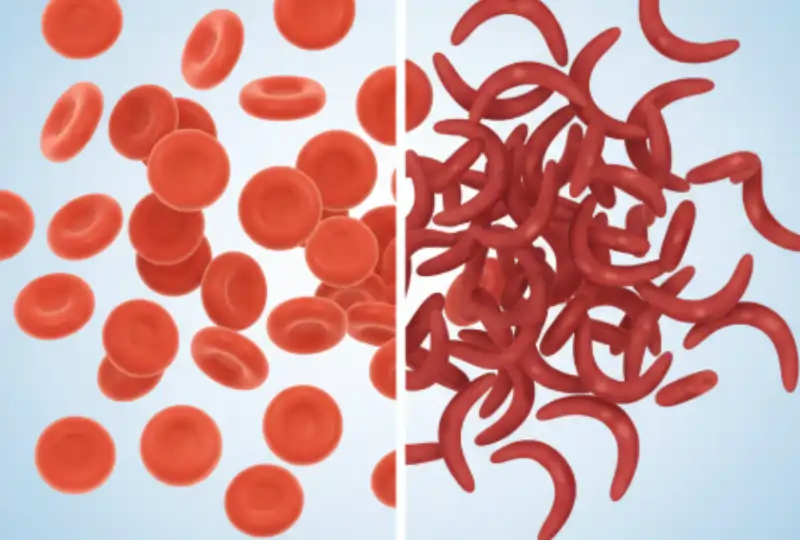
Sickle cell disease is a genetic blood disorder where red blood cells take on an abnormal crescent or sickle shape instead of the normal round shape.
Healthy red blood cells are flexible and move easily through blood vessels. Sickle cells are rigid and sticky.
They clump together, block blood flow, and cause severe pain episodes called sickle cell crises. Over time, they damage organs including the spleen, kidneys, lungs, and brain.
According to the Centers for Disease Control and Prevention, people living with sickle cell disease experience:
- Repeated episodes of intense pain, sometimes requiring hospitalisation.
- Increased risk of stroke, even in childhood.
- Chronic anaemia due to the rapid breakdown of sickle cells.
- Higher susceptibility to infections, particularly in early childhood.
- Reduced life expectancy compared to the general population, though this has improved significantly with modern care.
Nigeria has the highest number of sickle cell disease births in the world.
The Sickle Cell Foundation Nigeria estimates that about 150,000 babies are born with sickle cell disease in Nigeria every year, and many do not survive past age five without adequate medical care.
This is the human cost behind the genotype conversation, and it is why pre-marital genotype testing is one of the most important health decisions a Nigerian couple can make.
Can AS Carriers Live a Normal, Healthy Life?
Yes. People with the AS genotype are carriers, not patients.
Sickle cell trait (AS) is different from sickle cell disease (SS). Carriers have one normal haemoglobin gene that largely compensates for the sickle gene.
In everyday life, most AS individuals experience no symptoms at all and live completely normal, healthy lives.
There are some specific circumstances where AS carriers may experience mild complications:
- Extreme physical exertion at very high altitudes or in low oxygen environments.
- Severe dehydration, which can trigger sickling in rare cases.
- Certain high intensity athletic activities under extreme conditions.
These situations are uncommon and manageable. The American Society of Hematology confirms that the vast majority of people with sickle cell trait live healthy, normal lives without any significant medical complications.
What Should You Do Before Getting Married?
Know your genotype and know your partner’s genotype, ideally before the relationship becomes emotionally difficult to navigate.
Pre-marital genotype testing is simple, quick, and inexpensive. A blood sample is taken and analysed in a laboratory.
Results typically come back within hours at a reliable diagnostic centre.
Here is why testing before marriage matters more than testing after:
- It gives couples accurate information to make informed decisions together.
- It removes the guesswork and the anxiety of assumptions.
- It prevents the heartbreak of discovering a high-risk combination after marriage or after having children.
- It confirms whether a previous test result was accurate, as errors do occur.
If you are already married and have not been tested, testing still matters. Knowing your genotype helps you understand your children’s potential risk and plan your family accordingly.
For couples where both partners are AS, the conversation becomes harder but no less important. Options available in that situation include:
- Proceeding naturally with each pregnancy, knowing the 25% risk per pregnancy.
- Prenatal diagnosis through specialist medical centres to check the baby’s genotype during pregnancy.
- Consulting a genetic counsellor for personalised guidance.
These are deeply personal decisions that require accurate information first.
Frequently Asked Questions.
Can AA and AS couples have a child with SS?
No. It is genetically impossible for an AA and AS couple to produce an SS child. The AA parent can only pass the A gene, so the worst outcome for any child of this combination is AS (carrier), not SS (sickle cell disease).
Is AS genotype dangerous?
No, not in everyday life. People with AS (sickle cell trait) are carriers and are generally healthy. The S gene only causes sickle cell disease when a child inherits two S genes, one from each parent. A single S gene does not cause disease.
What if my genotype result says AA but I am not sure it is accurate?
Genotype results can occasionally be inaccurate, particularly from poorly equipped laboratories. If you have any doubt about a previous result, repeat the test at a certified, accredited diagnostic centre before making major life decisions based on it.
What is the difference between genotype and blood group?
Genotype refers to the type of haemoglobin genes you carry (AA, AS, SS, etc.) and relates to sickle cell risk. Blood group (A, B, AB, O) is a completely separate classification based on antigens on the surface of your red blood cells. The two are unrelated.
At what age should someone get a genotype test?
There is no minimum age. Genotype testing can be done at any age, including at birth. For adults, the most important time to test is before entering a serious relationship or planning marriage, giving both partners complete information early enough to factor it into their decisions.
Can two SS people have a healthy child?
No. When both parents have SS, every child they have will also be SS. There is no genetic possibility of an AA or AS child from two SS parents.
Medical Terms Explained
- Haemoglobin: The protein inside red blood cells responsible for carrying oxygen around the body. Different haemoglobin types (A, S, C) behave differently and determine your genotype.
- Genotype: The specific combination of haemoglobin genes a person carries, inherited one from each parent. Common genotypes include AA, AS, SS, AC, and SC.
- Sickle cell trait (AS): A condition where a person carries one normal haemoglobin gene (A) and one sickle gene (S). Carriers are generally healthy but can pass the S gene to their children.
- Sickle cell disease (SS): A serious genetic blood disorder where both haemoglobin genes are the sickle type. It causes chronic pain, organ damage, anaemia, and other serious complications.
- Mendelian inheritance: The scientific principle that explains how genes are passed from parents to children. It forms the basis of genotype probability calculations used in genetic counselling.
- Haemoglobin electrophoresis: This laboratory test is used to determine a person’s genotype. It separates different types of haemoglobin in the blood to identify exactly which types are present.
- Genetic counselling: A specialist consultation that helps individuals and couples understand the genetic implications of their genotype combination and explore their options.
Key Takeaways
- AA and AS couples cannot produce an SS child. Every child they have will be either AA or AS.
- Sickle cell disease (SS) only occurs when a child inherits the S gene from both parents.
- Nigeria has the highest burden of sickle cell disease births in the world, with an estimated 150,000 cases per year.
- AS carriers are generally healthy and live normal lives. Having the trait is not the same as having the disease.
- Pre-marital genotype testing is the single most important step couples can take before marriage.
- Genotype and blood group are two completely different things and should not be confused.
- If you are unsure about a previous genotype result, repeat the test at a certified diagnostic centre before making any major decision.
Conclusion
AA and AS couples have nothing to fear from their genotype combination. The genetics are clear: no SS child can come from this pairing.
But this conversation is bigger than just one couple. Understanding your genotype, confirming it with an accurate test, and knowing what it means for your future children is one of the most responsible health decisions you can make.
Inova Diagnostics offers accurate, certified genotype testing through our automated laboratory services, with fast turnaround times and results you can trust.
Whether you are preparing for marriage, confirming an old result, or simply want to know your status, our team is ready to help.
Walk in anytime at No 6 Awori Crescent, Ilupeju, Lagos, or call 09044440438. We are open 24 hours a day, seven days a week.
Medically reviewed by Inova Diagnostics clinical team.