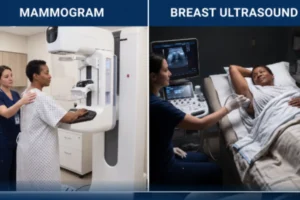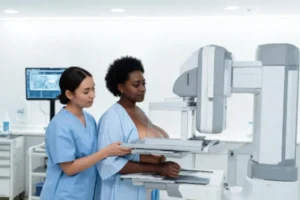
There are different tests used to examine breast tissue for abnormalities. These are called imaging tests.
The examples of such tests include mammograms, breast ultrasound, biopsy, and so on.
But, in this article, we will be focusing on the differences between mammogram and breast ultrasound, how they both work, what they can detect, and when they can be recommended.
Each of these tests mentioned can produce images of breast tissue in different ways and provide clear information.
No test is more vital or superior than the other, as your doctor can ask for one test or both depending on your age, the symptoms, your medical history, and what was found in your breast.
Is There Any Difference Between a Mammogram and a Breast Ultrasound?
If you have ever observed the following signs or symptoms in your breast, there is a need to seek urgent medical attention.
Some of these symptoms comprises lump in your breast or underarm, swelling in part of your breast, a noticeable change in the size or shape of your breast, unusual redness of the skin, or bloody nipple discharge.
These are among the signs and symptoms of breast cancer.
Most importantly, if you have had a mammogram before and it shows an abnormal result, even when you don’t have any symptoms yet, it is important to reach out to your doctor.
Yes, there is a huge difference between both tests. Let’s identify the differences using the table below.
Is There Any Difference Between a Mammogram and a Breast Ultrasound?
Yes, there is a huge difference between both tests. Let’s identify the differences using the table below.
| Feature | Mammogram | Breast ultrasound |
| How it works | Uses a low amount of X-rays | Uses sound waves |
| Radiation | Uses a small amount of ionising radiation | Does not use ionising radiation |
| Main role | It is a common breast cancer screening test for most women who require screening or diagnosi | This is normally used to find breast lumps and other abnormalities. |
| What it can show | Masses, cases where there are calcifications, and other breast changes | This can identify internal breast structures, including whether a lump is fluid-filled or solid. |
| Dense breast tissue | Dense tissue can make some abnormalities much harder to see. | This can provide more detailed information about certain abnormalities in dense breasts |
| Can it confirm breast cancer? | No, not by itself. | No, not by itself. |
| Can it guide a biopsy? | Yes, mammography can help guide biopsies. | Yes, ultrasound can also guide biopsies when the abnormality is visible on ultrasound. |
| Is it always needed alongside the other test? | No, mammogram tests are selected according to the situation at hand. | No, an ultrasound is also selected depending on one’s symptoms. |
These two tests can complement each other, but they have their different capacities and limitations
Which Is Better for Detecting Breast Cancer?
These tests can identify suspicious abnormalities that may indicate breast cancer, but they cannot confirm whether cancer is present.
A biopsy is generally needed to confirm a breast cancer diagnosis.
However, mammography is the common screening test for most women whenever screening is recommended.
It can identify some breast issues before their symptoms develop and may also detect calcifications that are difficult to identify using ultrasound alone.
For breast ultrasound, it is a different work altogether. One of its advantages is that your doctor can use it to know more about a lump or abnormality that requires deeper evaluation.
Most importantly, it can help differentiate a solid mass from cysts that are filled with fluid. Mammograms can mistake these two things as one.
In cases whereby the breast tissues are too dense, mammograms can become harder to interpret.
Ultrasound, however, can be useful here to identify issues that are not visible on a mammogram or other problems that may not be cancerous.
Dense breast tissue can make some abnormalities harder to see on a mammogram.
Why Would a Doctor Recommend an Ultrasound After a Mammogram?
If you have already undergone a mammogram, and your doctor also referred you for a breast ultrasound, here are some of the reasons for that:
- There were masses shown in the mammogram that needed to be correctly identified.
- When your radiologist needs to know whether the masses are fluid-filled or solid.
- When an abnormality needs more imaging to help decide whether a biopsy is necessary.
But even after breast cancer, there is a possibility for further tests, like follow-up imaging or biopsy. This entirely depends on what was found during the mammogram or ultrasound.
When Should You Get a Mammogram or Breast Ultrasound?
Your doctor can recommend any of the two tests based on certain factors. They include:
- When you have symptoms or are undergoing some routine screening.
- Your age.
- Where the lump is located and how it is.
- Your personal and family medical history.
- When you have previous breast imaging results.
- Whether there is a need for further assessment after an initial test.
Frequently Asked Questions
Is Breast Ultrasound Painful?
No. Breast ultrasounds are not painful, but you can feel the pressure a little bit. This can be uncomfortable for some people.
Does Breast Ultrasound Use Radiation?
No. It only uses sound waves. It does not use ionising radiation either.
Can a Mammogram Miss Breast Cancer?
Yes. Mammography does not detect breast cancer. In cases where there is dense breast tissue, it can make some abnormalities harder to see or interpret.
Conclusion
When your doctor refers you for a mammogram or ultrasound, there is always a reason behind it.
This is because they both use different technologies to provide different information, which is useful to your doctor to make decisions.
Don’t request a particular test just because others are doing so.
Always pay attention to what your doctor recommends, because the most appropriate test for you can depend on your age, the risk factors, and the main reason why the test needs to be done.
If you need any of these imaging services as advised by your doctor, Inova Diagnostics is here for you.
Send us a message or call the numbers on our contact page to learn more about our imaging services